
Category: Uncategorized

  • Are you Speaking to me?

    Are you Speaking to me?

    Wouldn’t it be amazing if God sent a message specially to you?  Baruch is a man who God sent a message to because he wanted him to know something about himself.  I found Jeremiah 45 to be a very challenging passage as I contemplated how it relates to me. You may find this passage pierces your heart like it did mine.

    Scripture

    “The word that Jeremiah the prophet spoke to Baruch the son of Neriah, when he wrote these words in a book at the dictation of Jeremiah, in the fourth year of Jehoiakim the son of Josiah, king of Judah: 2 “Thus says the Lord, the God of Israel, to you, O Baruch: 3 You said, ‘Woe is me! For the Lord has added sorrow to my pain. I am weary with my groaning, and I find no rest.’ 4 Thus shall you say to him, Thus says the Lord: Behold, what I have built I am breaking down, and what I have planted I am plucking up—that is, the whole land. 5 And do you seek great things for yourself? Seek them not, for behold, I am bringing disaster upon all flesh, declares the Lord. But I will give you your life as a prize of war in all places to which you may go.” (Jer. 45)

    Observation

    • This is a fascinating and very convicting chapter for me.  I have been following Jesus for 50+ years and yet this passage shows me I still need God to work on my heart! 
    • This chapter is a special message to Baruch who was an assistant to Jeremiah.
    • Back in chapter 36, Jeremiah asked Baruch to write down all of his prophecies for Judah. This would have taken days, weeks or months to accurately record those words.  
    • After hearing Baruch, the leaders took those prophecies to the king and read them but the king cut the scroll as they read it and threw the pieces into the fire.
    • God spoke this special message to Baruch because he was complaining. I am sure he was discouraged, grieved, and even disillusioned because all his work seemed to be for no benefit.
    • I am sure that Baruch was also afraid for his life because the leaders told him to go and hide for fear of the reaction of the king.
    • God’s message to Baruch was not, “so sorry this is hard Baruch, remember that I am working all things out for the My good.”  No, his message was, “stop seeking your own glory!  Stop being so selfish!”
    • His self-centeredness is revealed by Ryken when he notes,

    “He sounds even more self-centered in Hebrew, because nearly every word ends with a first person possessive pronoun: my woe, my pain, my being worn out, my groaning, my finding no rest. However much he may have hated his life, Baruch was still very deeply in love with himself!”

    • Ryken goes on to say,

    “Baruch’s complaint yields two important insights about depression. The first is that every complaint is finally a complaint about God. Ultimately Baruch was blaming God for his troubles. It was “the Lord” who had added sorrow to his pain. Even when it has a physical component, despair is always a spiritual matter. Dissatisfaction with life is dissatisfaction with God. “It is all God’s fault,” people say. “God gave me this lousy job. God made me sick. God took away my loved ones.” Whatever the trouble, God is to blame.

    As depression turns against God, it turns inward upon the self. Baruch could not see beyond the boundaries of his own troubles. He spent all his time thinking about how tired he was, how much pain he was in, how many griefs he had to bear. But God cut right to the heart of Baruch’s real problem: He was seeking something for himself.”

    Application

    • Ryken, who I am quoting extensively, really has hit me between the eyes with his insight. He continues,

    “At some time or other, every Christian wants to stand with the prophet in the presence of God and say, “Here I am, Lord. Use me! Send me! I will go anywhere. I will do anything. I will suffer everything for the sake of the gospel of Jesus Christ.”

    Yet there can be something very self-centered about that prayer. “Here am I. Send me!” Some Christians think the important thing is not that God’s will gets done, but that they get to do it. They are happy for God to get the glory as long as they can share some of the limelight. How hard it is to attempt great things for God without attempting them also for self!

    • Finally, he says,

    If you are waiting to do some great thing, you may be wasting God’s time. Most Christians will never do anything great. “Should you then seek great things for yourself? Seek them not” (45:5a). Instead, give your best for God in the small things. Be a good worker, lead one person to Christ, raise a godly family, support a missionary. The way to seek the glory of God is in the little things of the Christian life. Hudson Taylor (1832–1905) once said, “A little thing is just a little thing, but faithfulness in a little thing is a great thing.” Not a great thing for you, understand, but a great thing for God. God is glorified greatly by the little things done for his glory. Attempt small things for God! What does it take for a man like Baruch to stop seeking great things for himself? 

    The answer is that he must die to himself. The self will not stop seeking greatness until it is put to death. But once the self is dead, the only thing left is to attempt small things (or great things) for the glory of God.

    Prayer

    Father, what an insightful passage that reveals the ongoing struggle with my heart. As Ryken said, I desire to do great things for you and then when things do not go as I think they should, I gripe and complain.  I must examine my true motivation. Forgive me for my self-centeredness. Help me to live daily as someone who has died with Jesus on the cross and now is living to simply be faithful and obedient while allowing you to accomplish your will whatever it might be. Help me to remember daily that life is not about me.
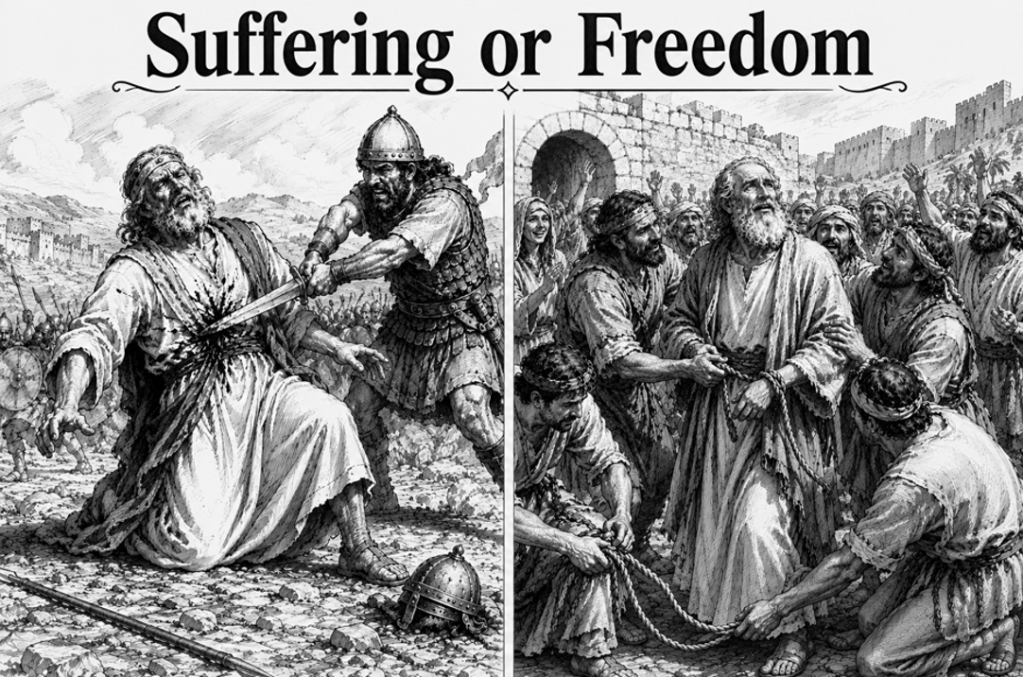
  • Suffering or Freedom

    Suffering or Freedom

    Uriah and Jeremiah faced very different results for their obedience…

    Scripture

    “At this time Uriah son of Shemaiah from Kiriath-jearim was also prophesying for the LORD. And he predicted the same terrible disaster against the city and nation as Jeremiah did. . . . The king then killed Uriah with a sword and had him buried in an unmarked grave. Nevertheless, Ahikam son of Shaphan stood up for Jeremiah and persuaded the court not to turn him over to the mob to be killed.” (Jer. 26:20–24)

    Observation (speak out)

    • This is an amazing story of two faithful prophets who proclaimed the same message of judgement against Judah for their sin as directed by the LORD.
    • Even though they proclaimed the same message, one was martyred and the other was set free,
    • Although we know a lot about Jeremiah, we know nothing about Uriah except his hometown.
    • Why did Uriah die because of his obedience and Jeremiah lived on because of his obedience?
    • It doesn’t seem fair to me although nothing is said about this concern in the text.

    Application (speak in)

    • It is easy for me to ask why some people who are faithful followers of God seem to experience more difficulty than others.
    • When I get lost in this dilemma, or feel sorry for myself, I need to regain my perspective and focus on what Uriah and Jeremiah had in common. They both faithfully followed and obeyed God.
    • Their obedience was not based on their circumstances or what would be the outcome of their obedience. They simply obeyed God regardless of what that meant for them and they trusted God to accomplish his will.
    • I need to remember that a life well lived is not a life lived without difficulty or problems. Rather, it is a life of obedience and faithfulness out of love for God regardless of how that impacts my circumstances.
    • This is easy to say but hard to live.

    Prayer (rejoice, repent, request)

    Father, thank you for being a wise, kind, loving and all-powerful God who always does what is best even when I do not understand. Help me to yield to your leadership and loving and willingly follow you.

  • Aging Well

    Aging Well

    S cripture

    “In the thirty-sixth year of the reign of Asa, . . . Then Asa took silver and gold from the treasures of the house of the LORD and the king’s house and sent them to Ben-hadad king of Syria, who lived in Damascus, saying, “There is a covenant between me and you, . . .At that time Hanani the seer came to Asa king of Judah and said to him, “Because you relied on the king of Syria, and did not rely on the LORD your God, the army of the king of Syria has escaped you. . . For the eyes of the LORD run to and fro throughout the whole earth, to give strong support to those whose heart is blameless toward him. You have done foolishly in this, for from now on you will have wars.” Then Asa was angry with the seer and put him in the stocks in prison. . . Asa was diseased in his feet, and his disease became severe. Yet even in his disease he did not seek the LORD, but sought help from physicians.” (2 Chron. 16:1-12)

    O bservations (what do I see?)

    • Asa had generally been a good king in Judah. He had been blessed by God to reign for 36 years!
    • In the 36th year, he failed to trust God. He tried to work things out on his own even though he knew better.
    • He did not respond well when a prophet confronted him with his sin. His heart had become hardened, and he persecuted the prophet rather than confess his sin to God.
    • His heart had become so calloused that he refused to seek God’s help even when he was sick.

    A pplication (what do I need to do?)

    • Asa is an example of a veteran follower of God who did not finish well.
    • I must be careful not to rely on my own wisdom or past successes. I must choose simple obedience to God each day.
    • I need a soft heart toward God when confronted with sin. I need to humbly admit it and ask for forgiveness.
    • I must not become complacent in life or in my relationship with God. I need to work hard to keep my friendship with God fresh and to continue finding my pleasure in Him! He is the only one who can truly satisfy me.

    P rayer (talk to God about it)

    Father, thank you for another warning of compromise and disobedience as we age. You have been so good to me; help me seek you first and not rely on myself. Help me to continue to see life as an exciting adventure of living with you. May the challenges of life not quench that spirit and perspective.

  • Exploring S.O.A.P. for Spiritual Growth

    Exploring S.O.A.P. for Spiritual Growth

    Hi everyone!

    I have officially retired from my pastoral role but will continue pursuing opportunities to teach the Bible and invest in others.

    Although I have not been using this site for a few years, I am kicking it off again and will begin sharing things that are encouraging me in my discipleship to Jesus. I’m not sure how often I will post, but I hope it’s once per week.

    I will be using a new outline when I share. It is called a S.O.A.P. outline.

    S = scripture,

    O = observations of what I see in the text,

    A = applications for my life, and

    P = will relate to my request for God to make what I have seen a reality in my life.

    This approach has been an encouragement to me, and I hope it will be for you as well.

    In addition, I will be using the NLT Chronological Bible for my daily reading. It is a great plan that allows you to read the Bible as a story, with helpful introductions for each day’s reading. I highly recommend it.

    Looking forward to following Jesus with you!

    Jeff

  • My Friend

    One of the greatest blessings in life is to have friends. Those who care for you, accept you the way you are and want what is best for you. I found the Urban Dictionary’s definition of a friend interesting. It says,

    “A friend is someone you love and who loves you, someone you respect and who respects you, someone whom you trust and who trusts you. A friend is honest and makes you want to be honest, too. . . A friend is someone who is happy to spend time with you.”

    As I was reading Ps. 25 today I was encouraged by verse 14 which says,

    “The LORD is a friend to those who fear him.”

    The LORD is the friend of all those who have embraced Jesus Christ as their Savior and God. The word “friend” in this passage is stressing,

    “The intimate relationship which Yahweh’s followers have with him.”

    (A Translator's Handbook on the Book of Psalms, p. 251)

    Father, thank you for the amazing reminder that you are my friend! I get to enjoy an intimate relationship with You! You love me, care for me, want what is best for me and will walk with me through the hills and valley’s of life. May I learn to live each day enjoying your presence and live in a way that pleases you.

    Following Jesus with you.

    Jeff

  • True Blessedness

    How would you describe “true blessedness”?  What is it about life that makes you truly happy and fulfilled?

    The older I have become, the more my family rises in importance for me.  I can say that I am truly blessed to have the family I do. Even though this may be the case, is that where true blessedness is found?

    I was struck this morning by something in Luke 11:27-28, which says,

    “As he said these things, a woman in the crowd raised her voice and said to him, ‘Blessed is the womb that bore you, and the breasts at which you nursed!’ But he said, ‘Blessed rather are those who hear the word of God and keep it!’”

    As Jesus was teaching the crowds, a woman cries out how blessed it must have been to be in the family of Jesus.  This anonymous woman is commending the son of Mary.  What a fantastic place to have grown up! 

    Do you see the response of Jesus?  He does not say, “yes, I was so fortunate!”  Instead, he says the real blessing is for anyone who hears and obeys God’s Word!  He does not deny that he may have had a great family, but he is saying, in comparison to hearing and following God’s Word, the blessing one receives through being relationally connected to God is not even in the same league! This type of blessing is available to all!

    Notice how Darrell Bock summarizes this scene,

    “The woman’s blessing of Jesus’ mother attempts to honor his family. It was not unusual to honor a mother in that culture by the accomplishments of her sons (Gen. 49:25; Prov. 23:24–25). But Jesus transforms the remark into another opportunity to declare where real blessing in life resides—in those who hear and obey God’s Word. Like the previous illustration, Jesus is focusing on the cruciality of receiving that Word. Richness and fullness of life are not a matter of biological or social origin, but relating well to the Lord of the universe (cf. 8:19–21).”[1]

    Father, I am so thankful for my family and friends.  You have truly blessed me.  But, in comparison to knowing you and being in your family through faith in Christ alone who died for my sin, it doesn’t even compare!  Help me enjoy the friends and family you have given me but keep me laser-focused on where true blessing is found. It is in hearing and obeying your Word which allows me to enjoy my relationship with you.

    Following Jesus with you,


    Jeff


    [1] Darrell L. Bock, Luke, The NIV Application Commentary (Grand Rapids, MI: Zondervan Publishing House, 1996), 324.

  • Abuse of Power

    The word “power” can be defined as the “authority, or influence over others.” In the encounter of David and Bathsheba, we see “power” in action.

    As I was reading through this familiar story today in my reading plan, I was impressed by the use of the word “sent.” This word is showing the “power” of an individual with authority over others.

    At first, in 2 Sam. 11:3, David does the “sending.”  He, in his kingly authority, “sent” and inquired about Bathsheba after noticing her.  He learned some essential information about her, as summarized by Robert Bergren,

    “The messenger reported that the woman was “Bathsheba, the daughter of Eliam and the wife of Uriah the Hittite”; thus, she was the daughter of one of David’s best fighters (cf. 23:34), the granddaughter of his most trusted counselor (cf. 16:23; 23:34), and the wife of one of his inner circle of honored soldiers (cf. 23:39). Since David was properly informed of this latter fact, for him to pursue Bathsheba further was already to commit adultery with her in his heart (cf. Matt 5:28).[1]

    This vital information did not stop David from abusing his power.  He then “sent” messengers to “take” Bathsheba (2 Sam. 11:4). To this point, David is the one with the power to “send.” 

    Things take a dramatic turn in verse 5 with our first plot twist by identifying another person with power when it says,

    “And the woman conceived, and she sent and told David, ‘I am pregnant.’”

    Here we learn that “David is not the only character who ‘sends’ in this episode, for Bathsheba sends a succinct message (only two words in Hebrew) that changes everything: ‘I am pregnant.” David exercised power in chapter 10 and thus far in chapter 11 by ‘sending.’ But when Bathsheba ‘sends,’ David must deal with a different kind of power. The power of wronged Bathsheba, the power of David’s own sin.”[2]

    This familiar account continues through the end of chapter 11 with David abusing his authority to “send” others to help him cover up his sin resulting in the eventual death of Uriah, Bathsheba’s husband.  

    Just when David thought he had things under control and no one would find out about his sin, the ultimate plot twist is found in 2 Sam. 12:1 which says, 

    “And the Lord sent Nathan to David.”

    It is now God who sends! This simple statement shows who is ultimately in charge! David did not get away with his abuse of power!

    Although this tragic story has far-reaching implications for David and his kingdom (2 Sam. 12:10-12), David owns his sin and confesses it to God. Unfortunately, David forgot that God is ultimately the one to whom he was accountable.  God alone is sovereign.  Any power David had was to be used in harmony with the character of God. He was just a steward of the power God had given him.

    Father, you, and you alone are the exalted King.  Any “power” we have (work, family, ministry, etc.) is given from you and should be exercised in harmony with your character and under your leadership.  David abused his position of power, which resulted in grievous sin.  Even with the facts before him, he could not be persuaded from his self-destructive path.  Help us to see the deception and power of sin. Help us to be alert and not turn a blind eye to behavior that can lead us astray or that is inappropriate.  Help us to always remember that you are the One to whom we are accountable, and we are only stewards of all that you have given us.

    Following Jesus with you,

    Jeff


    [1] Robert D. Bergen, 1, 2 Samuel, vol. 7, The New American Commentary (Nashville: Broadman & Holman Publishers, 1996), 364.

    [2] Bill T. Arnold, 1 & 2 Samuel, The NIV Application Commentary (Grand Rapids, MI: Zondervan, 2003), 528.

  • The Billboard of Life

    Have you noticed that some signs along the road catch your attention more than others? Some signs make me want more information while others I easily forget or even avoid. This morning I was impressed with the writer of Psalm 71 because he says that our lives are a “sign” to others.  Verse 7 says,

    “I have become a sign to many; you are my strong refuge.” (NIV)

    What is interesting about the word “sign” is summarized well by John Goldingay when he notes,

    “A sign (môpēt) is an extraordinary act of God, usually associated with a national event such as the exodus (e.g., 78:43; 105:5, 27). Only here is the idea applied to God’s dealings with an individual . . . Here too it is not the suppliant’s affliction that constitutes the solemn sign . . . but the suppliant’s deliverance by Yhwh.”[1]

    In our passage, the writer viewed his life as a “sign” or “example” of God’s protection and deliverance through his many troubles. In reality, he saw his life as a declaration of God’s faithfulness. This perspective impacted his attitude and how he lived his life.

    What message is the billboard of my life telling others about my belief in God? If I believe my life, like the Psalmist’s is a “sign” or “example” to others of God’s extraordinary protective care, my life becomes the opportunity to declare that to others by the way I live especially when challenging times come.

    Father, thank you for this amazing reminder of your faithful care of your children.  You have not abandoned us to live life on our own, but you walk with us through life.  When trouble comes, may I not complain or endure them with drudgery, but rather, may you help me to live above my circumstances knowing that you are my provider, protector, deliverer and faithful friend. May my life be another “sign” of your extraordinary care for your children.


    [1] John Goldingay, Baker Commentary on the Old Testament: Psalms 42–89, ed. Tremper Longman III, vol. 2 (Grand Rapids, MI: Baker Academic, 2006), 370.

  • HE answered ME!

    If you were going to write a Psalm, how would you start it?  The Psalmist in Psalm 120 started out with a simple declaration.  He said, 

    “. . . I called to the Lord, and he answered me.”

    The name of the Psalmist is unknown, but notice what he confidently said, “I called to the LORD, and HE answered ME.”

    The writer is describing a very personal and real experience with God!  He is not saying, “I wish God would answer me like he does other people I hear about.”  He simply said, I called to the LORD and he answered ME.” A simple statement of fact.  It is as though; everyone knows that is how it works in our relationship with God.  God is involved with each of his children individually. He knows what is happening in my life and loves me just like he loves all of his other children.  He cares, is concerned, listens and wants to help me!

    In our transition to my new role with Uniontown Bible Church, we have prayed about so many things. As you can imagine, there were many things that needed to happen to allow us to move including the sale of our home, a new home, place to stay in Maryland as we wait for our new home to be built, etc., etc., etc.  As we have seen each need fulfilled, are those things simply coincidences?  Or, is there a loving God who is intimately involved in my life that cares for me and helps me according to his plan?  God has used this time to remind me that he enjoys meeting the needs of his children! 

    This does not imply that God will answer everything exactly the way we asked, but that he cares, is involved and answers according to his will.  Some things in our transition did not go exactly as we had hoped, but we can now look back and see his hand everywhere in meeting our needs in his timing.

    You and I can still proclaim today the very thing the Psalmist said hundreds of years ago, “I called to the LORD, and he answered me.”

    I hope this simple reminder of God’s care for us individually gives you renewed hope and encouragement to continue talking to your Father and praise him for his concern and provision in your life.  

    Father, thank you that I can call to you, you hear me, and you care.  You alone are able to intervene in my life and I thank you for allowing me to see how much you care for me by leading us to Uniontown and for meeting all of our needs.

    Following Jesus with you,

    Jeff

  • Where Does The Power Come From?

    Where does the power to live the Christian life come from?  This question was proposed to Eric Liddell in the movie, Chariots of Fire.  Liddell was asked that question because he seemed to have an inner strength that set him apart from other runners.  His answer was, the strength comes from “within.”  He was describing an inner strength that God gave him not his own ability.

    That scene came to mind when I read Isaiah 40: 30-31 which says,

    “Even youths will become weak and tired, and young men will fall in exhaustion. But those who trust in the Lord will find new strength. They will soar high on wings like eagles. They will run and not grow weary. They will walk and not faint.” (NLT)

    In the context, we see that God is the only one who does not grow weary or tired (vs 29).  Isaiah is encouraging the readers to trust in God instead of their own strength as they considered the possibility of their imminent physical captivity by the Assyrians.  They needed to trust in God to find the strength needed to live through those difficult times.

    What does it mean to “trust in the Lord” (NLT) or “wait for the Lord” (ESV)?

    This concept of “trusting in God,” or “waiting on God,” is described by Gary Smith as “an active dependence on God that patiently awaits his timing with confident expectation.”[1]

    John Oswalt describes this concept as “not simply to mark time; rather, it is to live in confident expectation of his action on our behalf.”[2]

    So, this passage is telling us that “trusting in God” or “waiting on God” is not being passive but being actively dependent upon God as I eagerly anticipate his action on my behalf instead of relying upon myself.

    There is tremendous freedom in letting go and trusting God to lead our lives. An example of this truth is Philip Melanchthon, a friend of Martin Luther.  Philip was known to be a terrible worrier.  It has been said that there were often times where Luther would have to put his hand on Melanchthon’s shoulder and say, “Let Philip cease to rule the world.” I experience anxiety when trying to rule my life, don’t you? Instead, we need to let go and trust God to care for us in his time.

    How does this choice to trust in God give me strength?  Isaiah tells us that trusting in God will “renew” those who are worn out. This word is describing the “exchange” of weariness for new and better strength. A strength that only comes from God.

    Smith summarizes this concept well when he says,

    “This trust in God will replace any false leaning on a person’s own strength. . . This act of trust will enable God to replace human weakness with the powerful metaphorical soaring wings of an eagle (cf. Exod 19:4; Deut 32:11). Their weary legs will be transformed into strong legs that run fast; the fainting person will be able to walk for miles. Trust is never easy, but it is the key to unlocking God’s power. Trust enables people to walk the path (40:31) that God has chosen for their lives (whether it be pleasant or unpleasant) without growing weary or wanting to quit.”[3]

    How are you doing this morning? Are you weary? Are you trying to rule your world?  Do you need to replace fatigue with God’s strength?

    Father, thank you for the amazing promise to exchange my weariness with your strength.  This simply comes from my choice to stop depending upon myself, trust in you, and your plan for my life and is demonstrated by yielding to your leadership.  Help me to choose to trust you today and may my life reflect such trust in you.

    Following Jesus with you,


    Jeff


    [1] Gary Smith, Isaiah 40-66, vol. 15B, The New American Commentary (Nashville, TN: Broadman & Holman Publishers, 2009), 122.

    [2] John N. Oswalt, Isaiah, The NIV Application Commentary (Grand Rapids, MI: Zondervan Publishing House, 2003), 448.

    [3] Ibid.