Tag: god

  • Take my yoke. . .

    Take my yoke. . .

    Scripture

    Then Jesus said, “Come to me, all of you who are weary and carry heavy burdens, and I will give you rest. Take my yoke upon you. Let me teach you, because I am humble and gentle at heart, and you will find rest for your souls. For my yoke is easy to bear, and the burden I give you is light.” (Matt. 11:28-30)

    Observation (what do I see?)

    • Jesus invites all to come to him.
    • “Come,” “take” and “let” are all commands.
    • People must choose to come to Jesus as Savior and take his yoke of discipleship because he is God.
    • The reason to come to Jesus and take his yoke is because he is a humble and gentle master.
    • The fruit of this process of discipleship is that he gives internal rest to those who seek him.
    • Jesus describes his yoke as “easy.”
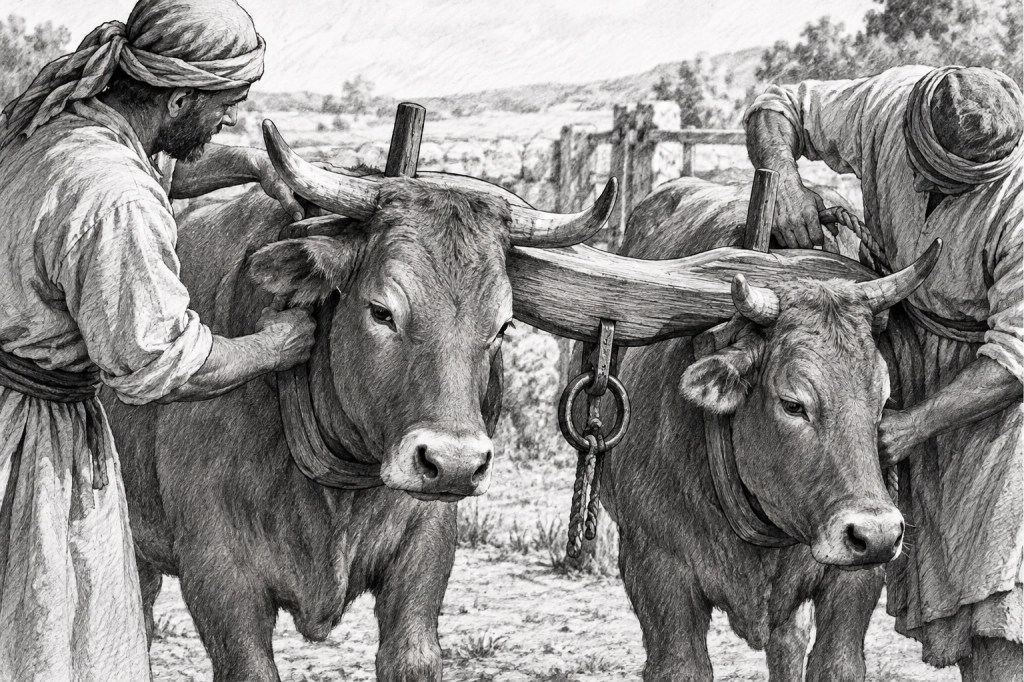
      • The word easy is in Greek chrēstos, which can mean well-fitting. In Palestine ox-yokes were made of wood; the ox was brought, and the measurements were taken. The yoke was then roughed out, and the ox was brought back to have the yoke tried on. The yoke was carefully adjusted, so that it would fit well, and not gall the neck of the patient beast. The yoke was tailor-made to fit the ox.“ There is a legend that Jesus made the best ox-yokes in all Galilee, and that from all over the country men came to him to buy the best yokes that skill could make. In those days, as now, shops had their signs above the door; and it has been suggested that the sign above the door of the carpenter’s shop in Nazareth may well have been: “My yokes fit well.” It may well be that Jesus is here using a picture from the carpenter’s shop in Nazareth where he had worked throughout the silent years. Jesus says, “My yoke fits well.” What he means is: “The life I give you is not a burden to gall you; your task is made to measure to fit you.”1
    • The yoke of Jesus is tailor-made for each person!

    Application (what must I do?)

    • The invitation to come to Jesus is a call for me to believe in him personally not to just acknowledge facts about him
    • Once I believe in Jesus, I need to take his perfectly fitting yoke upon me and learn from him. This is stressing the need for my submission and obedience. I must place myself under his authority, accept his teaching and live it out in all of my life.
    • His yoke is tailor-made for me not to produce sores but to allow me to live as he designed.
    • As I live under his leadership, I will find rest for my soul in the midst or life’s demands as I follow him.

    Prayer (talk to God about it)

    • Father, thank you for being a humble and gentle master. Thank you for designing your yoke to fit me. You know my strengths and weaknesses. I choose today to renew my desire to yield to your authority over my life. I look forward to learning from you and becoming the disciple you designed me to be.

    1 William Barclay, ed., The Gospel of Matthew, vol. 2, The Daily Study Bible (Philadelphia, PA: The Westminster John Knox Press, 1976), 17–18.

  • Are you Speaking to me?

    Are you Speaking to me?

    Wouldn’t it be amazing if God sent a message specially to you?  Baruch is a man who God sent a message to because he wanted him to know something about himself.  I found Jeremiah 45 to be a very challenging passage as I contemplated how it relates to me. You may find this passage pierces your heart like it did mine.

    Scripture

    “The word that Jeremiah the prophet spoke to Baruch the son of Neriah, when he wrote these words in a book at the dictation of Jeremiah, in the fourth year of Jehoiakim the son of Josiah, king of Judah: 2 “Thus says the Lord, the God of Israel, to you, O Baruch: 3 You said, ‘Woe is me! For the Lord has added sorrow to my pain. I am weary with my groaning, and I find no rest.’ 4 Thus shall you say to him, Thus says the Lord: Behold, what I have built I am breaking down, and what I have planted I am plucking up—that is, the whole land. 5 And do you seek great things for yourself? Seek them not, for behold, I am bringing disaster upon all flesh, declares the Lord. But I will give you your life as a prize of war in all places to which you may go.” (Jer. 45)

    Observation

    • This is a fascinating and very convicting chapter for me.  I have been following Jesus for 50+ years and yet this passage shows me I still need God to work on my heart! 
    • This chapter is a special message to Baruch who was an assistant to Jeremiah.
    • Back in chapter 36, Jeremiah asked Baruch to write down all of his prophecies for Judah. This would have taken days, weeks or months to accurately record those words.  
    • After hearing Baruch, the leaders took those prophecies to the king and read them but the king cut the scroll as they read it and threw the pieces into the fire.
    • God spoke this special message to Baruch because he was complaining. I am sure he was discouraged, grieved, and even disillusioned because all his work seemed to be for no benefit.
    • I am sure that Baruch was also afraid for his life because the leaders told him to go and hide for fear of the reaction of the king.
    • God’s message to Baruch was not, “so sorry this is hard Baruch, remember that I am working all things out for the My good.”  No, his message was, “stop seeking your own glory!  Stop being so selfish!”
    • His self-centeredness is revealed by Ryken when he notes,

    “He sounds even more self-centered in Hebrew, because nearly every word ends with a first person possessive pronoun: my woe, my pain, my being worn out, my groaning, my finding no rest. However much he may have hated his life, Baruch was still very deeply in love with himself!”

    • Ryken goes on to say,

    “Baruch’s complaint yields two important insights about depression. The first is that every complaint is finally a complaint about God. Ultimately Baruch was blaming God for his troubles. It was “the Lord” who had added sorrow to his pain. Even when it has a physical component, despair is always a spiritual matter. Dissatisfaction with life is dissatisfaction with God. “It is all God’s fault,” people say. “God gave me this lousy job. God made me sick. God took away my loved ones.” Whatever the trouble, God is to blame.

    As depression turns against God, it turns inward upon the self. Baruch could not see beyond the boundaries of his own troubles. He spent all his time thinking about how tired he was, how much pain he was in, how many griefs he had to bear. But God cut right to the heart of Baruch’s real problem: He was seeking something for himself.”

    Application

    • Ryken, who I am quoting extensively, really has hit me between the eyes with his insight. He continues,

    “At some time or other, every Christian wants to stand with the prophet in the presence of God and say, “Here I am, Lord. Use me! Send me! I will go anywhere. I will do anything. I will suffer everything for the sake of the gospel of Jesus Christ.”

    Yet there can be something very self-centered about that prayer. “Here am I. Send me!” Some Christians think the important thing is not that God’s will gets done, but that they get to do it. They are happy for God to get the glory as long as they can share some of the limelight. How hard it is to attempt great things for God without attempting them also for self!

    • Finally, he says,

    If you are waiting to do some great thing, you may be wasting God’s time. Most Christians will never do anything great. “Should you then seek great things for yourself? Seek them not” (45:5a). Instead, give your best for God in the small things. Be a good worker, lead one person to Christ, raise a godly family, support a missionary. The way to seek the glory of God is in the little things of the Christian life. Hudson Taylor (1832–1905) once said, “A little thing is just a little thing, but faithfulness in a little thing is a great thing.” Not a great thing for you, understand, but a great thing for God. God is glorified greatly by the little things done for his glory. Attempt small things for God! What does it take for a man like Baruch to stop seeking great things for himself? 

    The answer is that he must die to himself. The self will not stop seeking greatness until it is put to death. But once the self is dead, the only thing left is to attempt small things (or great things) for the glory of God.

    Prayer

    Father, what an insightful passage that reveals the ongoing struggle with my heart. As Ryken said, I desire to do great things for you and then when things do not go as I think they should, I gripe and complain.  I must examine my true motivation. Forgive me for my self-centeredness. Help me to live daily as someone who has died with Jesus on the cross and now is living to simply be faithful and obedient while allowing you to accomplish your will whatever it might be. Help me to remember daily that life is not about me.

  • Suffering or Freedom

    Suffering or Freedom

    Uriah and Jeremiah faced very different results for their obedience…

    Scripture

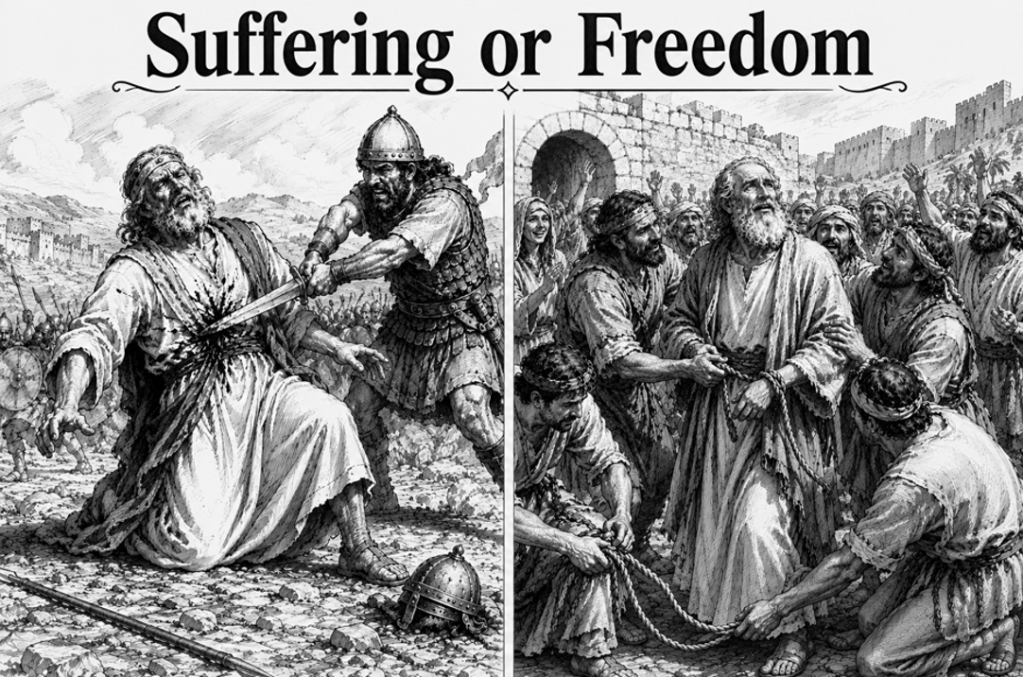
    “At this time Uriah son of Shemaiah from Kiriath-jearim was also prophesying for the LORD. And he predicted the same terrible disaster against the city and nation as Jeremiah did. . . . The king then killed Uriah with a sword and had him buried in an unmarked grave. Nevertheless, Ahikam son of Shaphan stood up for Jeremiah and persuaded the court not to turn him over to the mob to be killed.” (Jer. 26:20–24)

    Observation (speak out)

    • This is an amazing story of two faithful prophets who proclaimed the same message of judgement against Judah for their sin as directed by the LORD.
    • Even though they proclaimed the same message, one was martyred and the other was set free,
    • Although we know a lot about Jeremiah, we know nothing about Uriah except his hometown.
    • Why did Uriah die because of his obedience and Jeremiah lived on because of his obedience?
    • It doesn’t seem fair to me although nothing is said about this concern in the text.

    Application (speak in)

    • It is easy for me to ask why some people who are faithful followers of God seem to experience more difficulty than others.
    • When I get lost in this dilemma, or feel sorry for myself, I need to regain my perspective and focus on what Uriah and Jeremiah had in common. They both faithfully followed and obeyed God.
    • Their obedience was not based on their circumstances or what would be the outcome of their obedience. They simply obeyed God regardless of what that meant for them and they trusted God to accomplish his will.
    • I need to remember that a life well lived is not a life lived without difficulty or problems. Rather, it is a life of obedience and faithfulness out of love for God regardless of how that impacts my circumstances.
    • This is easy to say but hard to live.

    Prayer (rejoice, repent, request)

    Father, thank you for being a wise, kind, loving and all-powerful God who always does what is best even when I do not understand. Help me to yield to your leadership and loving and willingly follow you.

  • Aging Well

    Aging Well

    S cripture

    “In the thirty-sixth year of the reign of Asa, . . . Then Asa took silver and gold from the treasures of the house of the LORD and the king’s house and sent them to Ben-hadad king of Syria, who lived in Damascus, saying, “There is a covenant between me and you, . . .At that time Hanani the seer came to Asa king of Judah and said to him, “Because you relied on the king of Syria, and did not rely on the LORD your God, the army of the king of Syria has escaped you. . . For the eyes of the LORD run to and fro throughout the whole earth, to give strong support to those whose heart is blameless toward him. You have done foolishly in this, for from now on you will have wars.” Then Asa was angry with the seer and put him in the stocks in prison. . . Asa was diseased in his feet, and his disease became severe. Yet even in his disease he did not seek the LORD, but sought help from physicians.” (2 Chron. 16:1-12)

    O bservations (what do I see?)

    • Asa had generally been a good king in Judah. He had been blessed by God to reign for 36 years!
    • In the 36th year, he failed to trust God. He tried to work things out on his own even though he knew better.
    • He did not respond well when a prophet confronted him with his sin. His heart had become hardened, and he persecuted the prophet rather than confess his sin to God.
    • His heart had become so calloused that he refused to seek God’s help even when he was sick.

    A pplication (what do I need to do?)

    • Asa is an example of a veteran follower of God who did not finish well.
    • I must be careful not to rely on my own wisdom or past successes. I must choose simple obedience to God each day.
    • I need a soft heart toward God when confronted with sin. I need to humbly admit it and ask for forgiveness.
    • I must not become complacent in life or in my relationship with God. I need to work hard to keep my friendship with God fresh and to continue finding my pleasure in Him! He is the only one who can truly satisfy me.

    P rayer (talk to God about it)

    Father, thank you for another warning of compromise and disobedience as we age. You have been so good to me; help me seek you first and not rely on myself. Help me to continue to see life as an exciting adventure of living with you. May the challenges of life not quench that spirit and perspective.